
This article was first published in BusinessDesk on 6 January 2026.
Prepare for “coffee-badging” and big emotions if you plan on making 2026 the year you enforce a return-to-office mandate, or consider incentives to head that off, perhaps including a better address that boasts a full bar service and a sauna. “I might sound a bit like a hippie, but the energy is everything in a business,” said Nick Lissette, chief executive of data technology company Blackpearl Group.
“People now have a bit of a dedicated home office set up, where maybe five years ago they didn’t, and people get sick of commuting.
“You’ve got to make an exceptional environment if you want to have people wanting to turn up to the office, wanting to collaborate.”
Lissette said he found those features when Blackpearl expanded from its Wellington head office and leased satellite space at 1 Albert in Auckland’s CBD.
“They’re phenomenal operators that make considerable effort creating a really motivating working space,” he said.
Resistance tactic
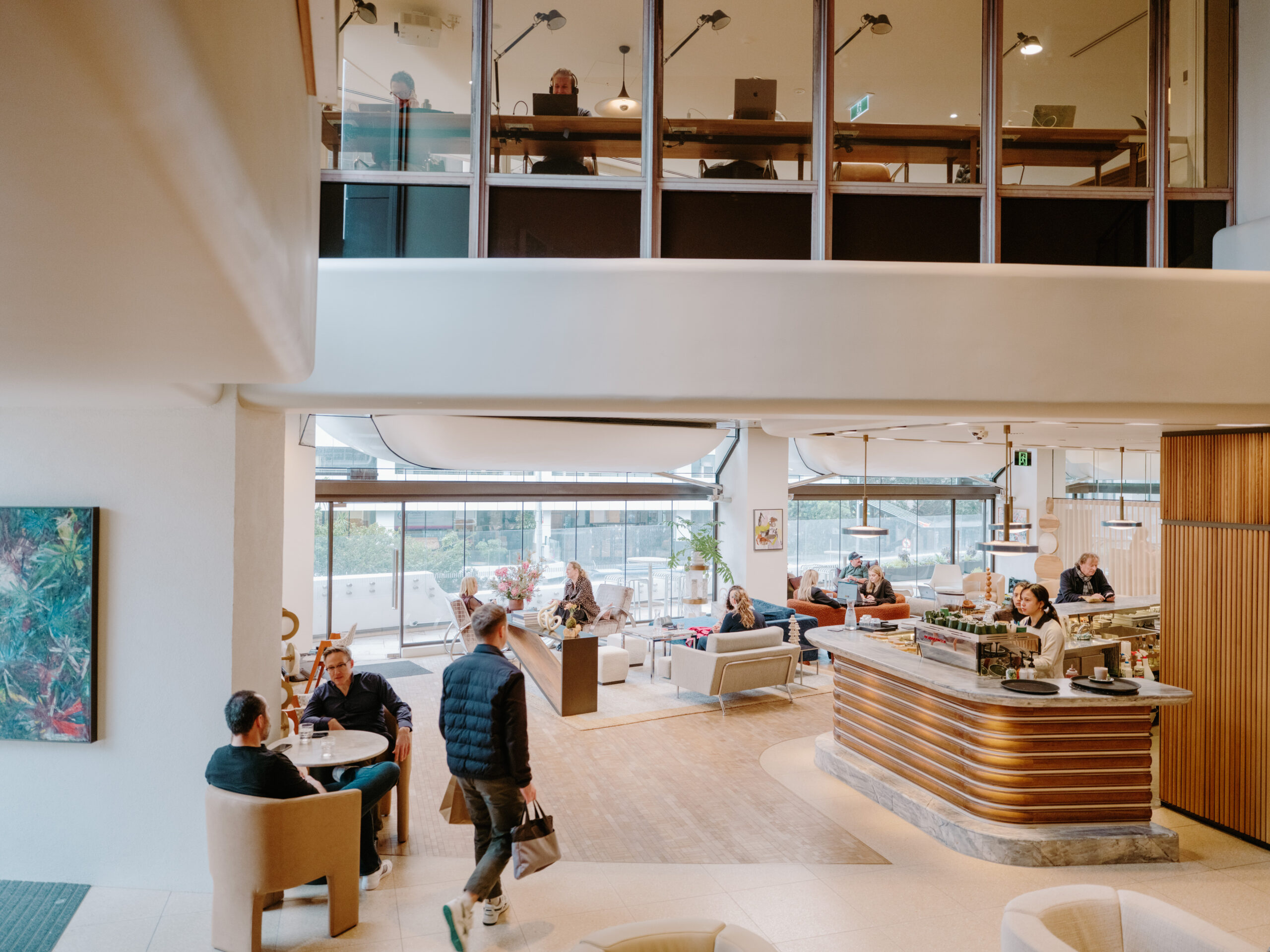
The building owner provides concierge services, dining and catering, two private club lounges with bar staff, and sauna, ice shower and fitness facilities among its tenant services bundled with more conventional offices, meeting rooms and boardrooms.
As for coffee-badging, that’s one resistance tactic social scientist Barbara Plester noted as she studied hybrid work and office work in tech and manufacturing.
“People who are forced to go back into the office will go in, do a coffee, make it fairly obvious they’re there, and then sneak off back home,” said the author of Hybrid Happiness: Fun and Freedom in Flexible Work and associate professor in the University of Auckland department of management and international business.
Plester warns that employees and managers alike will find reducing any flexibility in a work-from-home policy highly charged.
“When you can work hybrid, people feel trusted. And that’s really important to them, and they’ve got autonomy. Those two big things are huge,” Plester told BusinessDesk via a video call from her home office.
“When you take that back, then you’ve got to compensate a little by making it pleasant to be back.”
Appealing workplaces
There is definitely a knack to luring back employees that some HR managers quietly refer to as TWaTs – those who show up only on Tuesdays, Wednesdays and Thursdays.
“You don’t want to be infantilising people, saying here’s lollies for turning up,” said Plester.
She said incentives like free coffee, fruit or other food can work if that’s what employees value, but she’s seen businesses succeed with re-integrating into the office when they talk to employees about what would make their workplace more appealing.
“People had asked for a basketball hoop, and they’d put it up,” she noted at one site she visited while researching her book.
Well-stocked bar
BusinessDesk observed no basketball hoops when it visited 1 Albert and The Formery, two properties owned and managed by Andrew Saunders’ Quattro Group under the Alberts brand.
We’d made our way off the street to a smiling concierge and were waved past the on-site security – a former member of the British Parachute Regiment, we were quietly informed.
The members’ bar, several floors above Auckland’s Albert St at midtown, seemed well stocked, the lounge well attended, and the adjoining meeting rooms offered no vacancies as one of the tenants conducted a commercial mediation with a large group of visitors.
“We’re ultimately a global model,” said Quattro Group managing director Mark Gedye.
“As we expand our portfolio, initially in Sydney and then elsewhere, we’re going to be able to provide extension of our club spaces around the globe.”
As Gedye side-sat BusinessDesk on a comfortable couch in the bar, his colleague and chief commercial officer, Luke Condon, leaned forward over the coffee table to take up the pitch.
“We’re very aware of the Soho House model, which works very well as a hotel,” said Condon, referring to the global chain of private clubs that focus on media, fashion and creative industries.
“We looked at the WeWork model, which had been very successful, but again, wasn’t creditworthy, because it’s just short-term leases,” he said.
“Soho House generally doesn’t own its own buildings; it just has the lease. Same with WeWork.”
Creating a community
With Alberts, Condon said Quattro Group had attempted to combine flexibility, exclusivity and amenity in a sustainable capital structure.
“We’re an investor and we’re an operator,” he said.
“When we own the building, we can actually pivot and be flexible around what we’re doing – the uses of the building – in order to help drive the hospitality element that we put into the building, which is then creating all these club spaces, which is designed to create a community for all of our tenants.”
Gedye said their 1 Albert building deliberately catered to 55 small and medium-sized enterprises rather than letting the entire building to six larger corporate tenants on what would be more typical commercial terms.
“It’s 55 CFOs, CEOs, right? They all work and congregate within that space. It’s fascinating to see it develop,” he said.
Condon said aiming at larger numbers of smaller tenants helped to maintain an 87% retention rate through a challenging economic cycle.
“Our focus is on small and medium-sized businesses, where you have key decision makers who are deciding whether to come into the space.
“For them, what we’re trying to do is make it easy for them to get their employees back in and to increase the productivity of those employees by having an environment that their employees, I guess, want to be in rather than being actually at home.”
Lissette said Blackpearl operates that policy with a degree of flexibility, “but ultimately, we want to see everyone in the office”.
Growth had seen Blackpearl move from a couple of co-working spaces to a private suite of 12 workstations, with Alberts looking at offering an entire floor plate over one level for future growth.
“It’s a really great way of scaling up and doing that in a way where you’re not just relying on remote working,” said Lissette. “The trouble about remote working is that you miss out on spontaneous innovation, you know? Yelling at the desk next door and grabbing a whiteboard and having at it.”
Employee welfare
He said a Blackpearl product, which tracks and analyses anonymous business website visits to generate actionable leads, had arisen from a chance conversation in the office.
“Pearl Diver, which has got over $10 million in annual recurring revenue, was the CTO Sam Daish and myself locking in and drawing up on a whiteboard; 45 days later, that product was in paying customers’ hands.
“That would never have happened if we were working from home,” Lissette said.
High performance was not Blackpearl’s only driver for a return-to-office mandate, as employee welfare and its impact on work also mattered.
“It’s so easy to mask if you’re not happy, or if someone’s struggling or overwhelmed, remotely. “You have a 30-minute team meeting, people’s cameras are off, or filters are on. You can’t really understand where people’s minds are at,” said Lissette.
Network of partnerships
As BusinessDesk reported in November, NZX-listed Blackpearl undertook an $11.8m raise to support listing on the ASX, with backing from Wilson Asset Management, Ellerston Capital, Cooper Investors, Salter Brothers and Blackwattle Investment Partners, which have tens of billions under management.
Lissette said the required roadshows with institutions and brokers had allowed him to test Alberts’ network of partnerships with other work clubs in the financial districts of Sydney and Melbourne.
“There’s nothing worse when you’re travelling for work, and you’re homeless, checked out of your hotel, and you have nowhere to go for the whole day until your flight home. “Having offices to work out of which mirror that vibe and environment is just so handy.”